
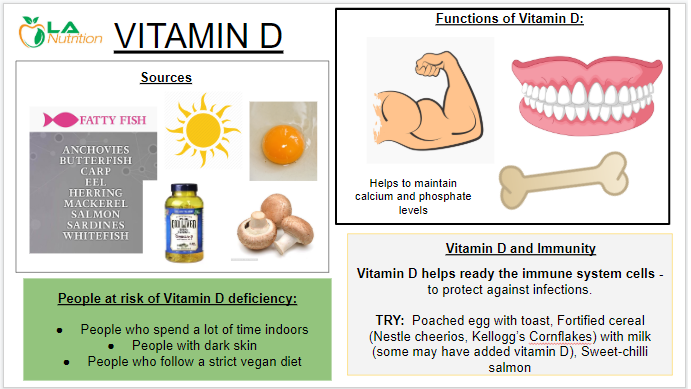
Vitamin D is mainly created by the body from sunlight from early April to the end of September, but from October to early March we don’t get enough vitamin D from sunlight!
Good sources of foods containing vitamin D include:
1. Oily fish – e.g. salmon, sardines, herring and mackerel
2. Red meat
3. Liver
4. Egg yolks
5. Fortified foods – spreads and some breakfast cereals
Another option is – dietary supplements.
But why do I need Vitamin D?
It helps to maintain calcium and phosphate levels in the body – which are needed to keep and make healthy bones, teeth and muscles.
Other research has also suggested a relationship between Vitamin D and the ”common cold”. The relationship being – ”higher levels of Vitamin D and lower incidence of cold symptoms”
Association Between Serum 25-Hydroxyvitamin D Level and Upper Respiratory Tract Infection (URTI) in the Third National Health and Nutrition Examination Survey.
Methods: Examined the association between 25(OH)D level and recent URTI in 18 883 participants 12 years and older.
Conclusions: Serum 25(OH)D levels are inversely associated with recent URTI. This association may be stronger in those with respiratory tract diseases.
Although a relationship does not mean causation (i.e. Those who have higher vitamin D levels will have a lower incidence of UTRI OR Those with low levels of Vitamin D will more suspectible to UTRI) it is believed vitamin D plays a key role in helping the immune system cells become ready for use and help to fight infection.
So it is important to get enough vitamin D to maintain a healthy body, and to help fight infections (Especially in winter due to low sunlight.)
Ginde, A., Mansbach, J. and Camargo, C. (2009). Association Between Serum 25-Hydroxyvitamin D Level and Upper Respiratory Tract Infection in the Third National Health and Nutrition Examination Survey. Archives of Internal Medicine, 169(4), p.384.
Science, M., Maguire, J., Russell, M., Smieja, M., Walter, S. and Loeb, M. (2013). Low Serum 25-Hydroxyvitamin D Level and Risk of Upper Respiratory Tract Infection in Children and Adolescents. Clinical Infectious Diseases, 57(3), pp.392-397.
von Essen, M., Kongsbak, M., Schjerling, P., Olgaard, K., Ødum, N. and Geisler, C. (2010). Vitamin D controls T cell antigen receptor signaling and activation of human T cells. Nature Immunology, 11(4), pp.344-349.