
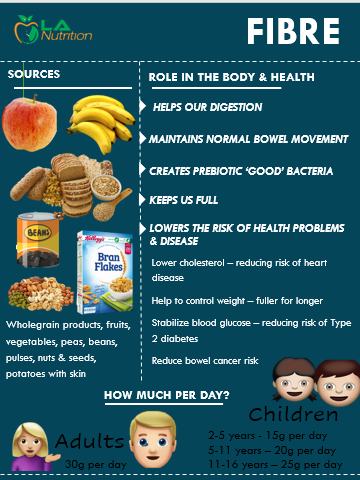
Many of us do not eat enough fibre. The recommended intakes for adults is 30 grams per day, and between 15 – 25 grams per day for children. On average, we are getting less than 20 grams per day.
Why is it important?
Dietary fibre has been consumed for many years, and it’s recognised for having many health benefits –
- It helps with our digestion,
- It helps us to maintain normal bowel movement, reducing risk of constipation
- It helps to feed the good micro-organisms in our gut – which are needed for nutrient & mineral absoprtion, & production of short-chain fatty acids (SCFAs).
High fibre diets are also suggested to lower the risk of and be protective against – coronary heart disease, stroke, disease and obesity.
What is dietary fibre?
Dietary fibre is a type of carbohydrate, which is resistant to digestion and can be found in plant foods – cereals, fruits, vegetables, peas, nuts, lentils and grains.
Fibre & Bowel Movement
There are two main types of fiber – insoluble, and soluble.
- Soluble fibre – absorbs water & helps to soften our faeces.
- Insole fibre – adds bulk to our faeces which stimulates movement of faeces
Foods high in soluble fibre – oatmeal, strawberries, apples, beans, peas, lentils
Foods high in insoluble fibre – brown rice, couscous, carrots, potatoes, parsnips, cucumbers, courgettes, nuts & seeds
Fibre & Gut Microbiota
Gut microbiota are essential for the fermentation of the non-digestible substrate, dietary fibre. This allows the growth of specialist microbes that produce short chain fatty acids (SCFAs) and gases.
The major SCFAs that are produced are – acetate, propionate & butyrate. In mice – butyrate & propionate, has been found to reduce appetite and food intake.
Fibre and Energy Intake
High-fibre foods have a lower energy density (fewer calories per gram), which means you can eat more for less calories! High-fibre foods also absorb water & contribute to bulking, this can help us to feel fuller for longer – and can help you to eat less. A feeling of fullness is likely to stop us from reaching for extra calories & nutrients in our diet.
What should I eat?
Aim for 25 grams per day to begin with, and then increase gradually to 30 grams per day.
Breakfast:
- 30g of Bran Flakes (5g fibre), 100 grams of berries (2.5g fibre), = 7.5g of fibre
Lunch:
- 1 Baked potato (2.5g fibre), 1/2 can of reduced sugar & salt baked beans (9g fibre) = 11.5g fibre
Dinner:
- Wholewheat pasta (6g fibre), with mixed vegetable tomato based curry (3g fibre) = 9.5g of fibre
Snacks:
- Apple (1g fibre)
- 30g of nuts (3g fibre)
- Some cereal bars contain added fibre – but watch for added fat & sugar!