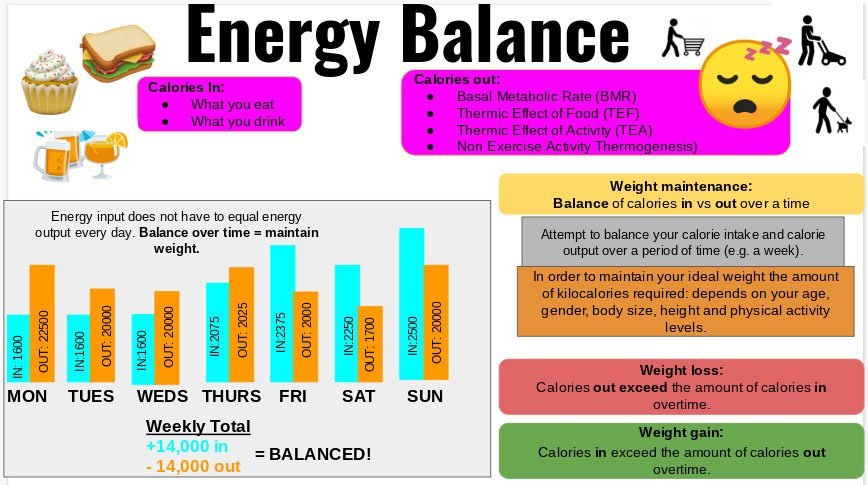
So my last blog, touched on energy balance. I’m trying to get a flow going in posts, and make them shape around one another so I thought I’d talk little on energy balance, the role in weight loss, gain and maintenance.
Us humans, take in energy in the form of protein, carbohydrate, fat and alcohol and then we use this energy for bodily functions and requirements which is known as the Body’s Basal Metabolic Rate (BMR), absorbing and metabolizing food consumed (Thermic Effect of Food – TEF) and for physical activity (Thermic Effect of Activity & Non Exercise Activity Thermogenesis – TEA/ NEAT).
So what is energy balance?
Basically, it is the difference in the energy you input into your body (number of calories) and the energy output required for the activities listed above (BMR+TEF+TEA+NEAT).
Basal Metabolic Rate (BMR) –
- Number of calories your body requires just at REST to keep it functioning correctly!
- Accounts for 60-70% of your Total Daily Energy Expenditure (TDEE).
Thermic Effect of Food (TEF) –
- The amount of extra energy required above BMR to digest and absorb nutrients after a meal
- Accounts for around 10% of your TDEE
Thermic Effect of Activity (TEA) –
- The amount of extra energy expended above BMR to perform physical activity
- Accounts for 15-30% of your TDEE
Non Exercise Activity Thermogenesis –
- The amount of extra energy expended for everything we do that is not sleeping, eating or sports-like exercise
- The amount it accounts with TDEE can vary widely within populations (e.g. due to job, body size, genetic factors)
How many calories do we require?
It is often suggested that – a man requires around 2,500kcal a day to maintain his weight and a woman will require around 2,000kcal a day. However, kilocalorie requirement varies! This can be due to differences in many factors including: age, body size, height, weight, physical activity levels and health status.
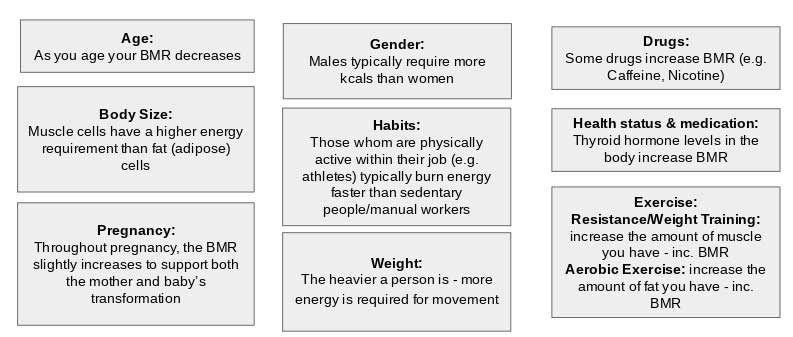
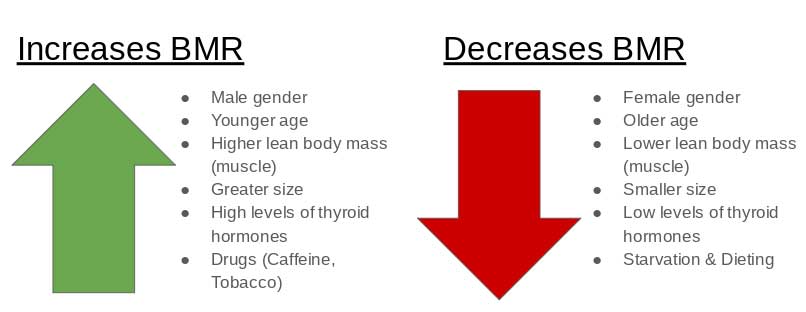
So how do we calculate how many kilocalorie my body needs?
Indirect calorimetry is one of the most accurate methods utilised for calculating your body’s specific daily energy requirement, however requires expensive equipment.
Many estimate the body’s energy requirement from numerical calculations and formulas – the Harris-Benedict Equation and Mifflin-St Jeor equation are two examples often used to calculate your BMR and take into account your gender, height, weight, and age. The BMR generated from this equation then is multiplied by an activity factor to determine your total daily energy expenditure (TDEE) and useful for health and body weight.
The need / or desire to lose, maintain, or gain weight will affect how many calories that they are consuming.
In order to lose weight: you must take in less energy than you utilise
In order to gain weight: you must take in more energy than you utilise
In order to maintain your weight: the amount of energy you take in must equal the amount of energy that you utilise.
Contact me today – for more information! I can calculate your kilocalorie requirement, and help you reach those weight loss or weight gain goals! OR even help you to manage your own weight!